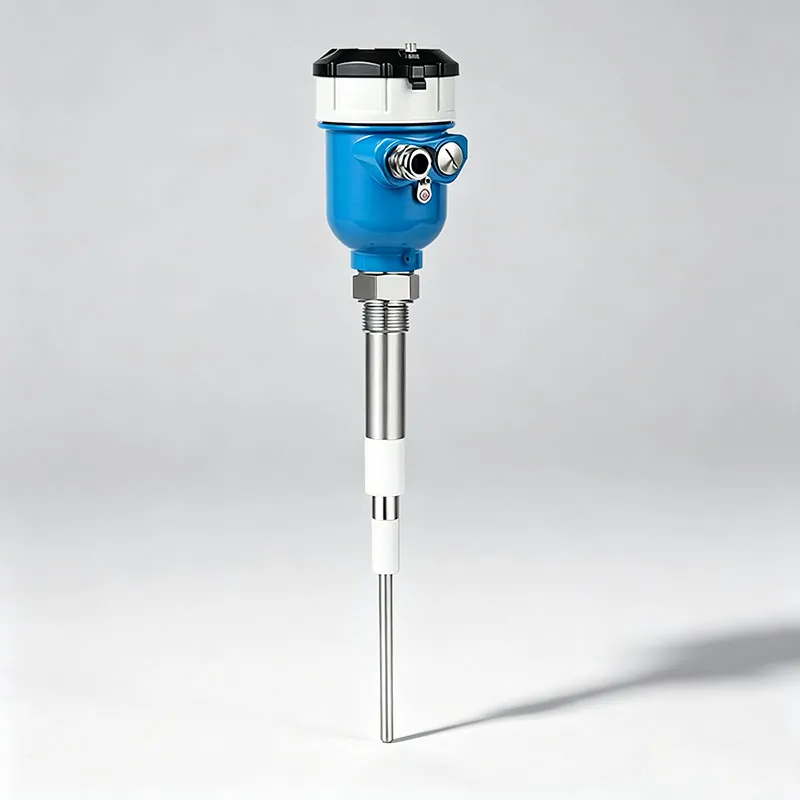
A point-level switch for powders or granules must operate in a material that can pile, bridge, compact, flow unevenly and create dust. Begin with bulk density and its expected range, particle size and shape, moisture, temperature, abrasiveness and tendency to coat or harden. The alarm may indicate high level, empty hopper or blocked transfer, but the material surface may not be flat. Place the sensing point according to the real flow pattern and consequence of a false or missed switch.
Mechanical loading can be more important than nominal vessel pressure. Filling streams may strike a probe, material can pull on a long cable, and a collapsing bridge can impose a sudden load. Rotary, vibrating, capacitance or RF-admittance principles have different probe shapes and responses to low density or coating. A protective roof or alternate mounting point may be appropriate, provided it does not create a pocket that prevents material contact. Provide the filling direction and expected forces with the vessel sketch.
Top and side mounting solve different tasks. A side-mounted high switch can be accessible but may sit in a stagnant buildup zone. A top-mounted cable can reach a lower point but needs vertical clearance, support and a defined dead or inactive section. Dust ingress, hazardous dust atmosphere, vibration, ambient temperature and electrical connection affect the housing. Output logic must identify normal, covered, uncovered, fault and power-loss states, especially when the switch stops a conveyor or prevents overfilling.
The TYCK solid-level-switch products below provide a principle and construction shortlist. For an RFQ, give material safety information, bulk density range, particle and moisture behaviour, vessel and nozzle drawing, mounting point, insertion length, filling impact, pressure, temperature, output and area classification. Ask for probe mechanical limits, minimum material conditions, buildup guidance, test method and exact certificates for the selected code. A successful application in one powder should not be treated as proof for another without review.